Latest Status
On May 29, 2026, the Office of Management and Budget (OMB) proposed new regulations that would introduce greater political intervention, termination authority, and compliance requirements for all federal grants and contracts. On Aug. 8th, the Senate voted 90-6 to pass legislation to fund the federal government at existing levels through Dec. 11th and block implementation of OMB’s rule through that timeframe. The House passed this same legislation on September 1st, and President Trump signed it into law shortly after.
Background
OMB’s proposed Regulation for Federal Financial Assistance would significantly overhaul federal grantmaking by codifying increased oversight by political appointees of federal grants, with the stated goal of improving “transparency, accountability, and oversight for Federal awards across the Federal Government” and to “reduce recipient burden.” The proposal would apply to virtually all federal grants and cooperative agreements, totaling approximately $1.2 trillion per year, roughly 15% of which ($179 billion) goes to small entities. The public comment period on the rule ended on July 13, with the intent to issue a final rule effective by October 1st, 2026 (the start of FY2027).
The proposal would extensively rewrite the “Uniform Guidance” that has been in place since 2014 (updated in 2020 and 2024), amending 91 parts across 256 different sections of these existing rules. At the highest level, it would further consolidate OMB’s regulatory authority, immediately applying the new rules and any subsequent revisions across the government without the need for agency-specific rulemaking processes.
The proposed rule would codify increased oversight by political appointees at each stage of the grantmaking process, including award topic selection, recipient selection, grant implementation, potential award cancellation, and any post-cancellation grantee challenges.
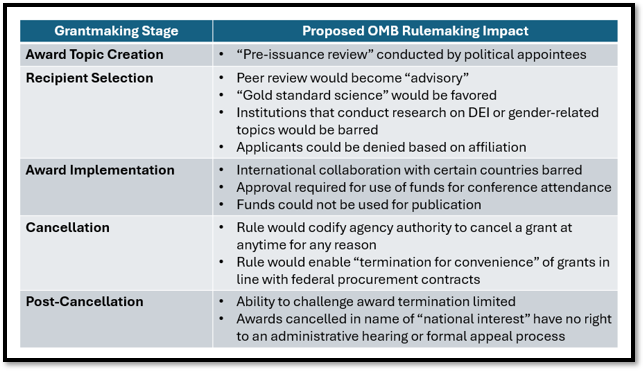
At the award creation stage, political appointees would be required to carry out a “pre-issuance review” to ensure awards “advance the President’s policy priorities.”
At the recipient selection stage, the rule would codify that the peer review process would be “advisory and does not replace agency discretion.” Political appointees would be empowered to prioritize “Gold-standard science.” This is a reference to 2025 Executive Order that would effectively bar any funds for institutions that conduct research related to DEI or what the administration refers to as “gender ideology.” Applicants could also be denied based on organizational affiliation, and agencies could restrict eligibility based on Internal Revenue Code designation (for instance by limiting eligibility to 501c3 nonprofits and excluding 501c4s).
After recipients have been awarded funds, the proposed rule would place limits on implementation. It would prohibit funds from being used on international collaborative efforts linked to covered foreign entities. Additional restrictions would include limits on using federal funds to support conference attendance and publication-related expenses, along with general efforts to reduce allowable indirect costs. Furthermore, the proposed rule would codify the authority to cancel a grant at any time for any reason, even mid-award. The rule would effectively put federal grantmaking in line with “termination for convenience” provisions for federal procurement contracts.
Should a grantee or awardee face cancelation, the ability to challenge the decision, appeal, or seek relief would be limited by the rule. Awards terminated in the name of the “national interest,” for instance, would not have the right to an administrative hearing or formal right to object within the agency.
CEBN’s Take
Given the sweeping nature of changes proposed under this rulemaking, this proposal could create significant uncertainty for federal grant applicants and awardees and increase administrative and compliance costs for recipients. Additionally, the changes proposed raise questions about expanded potential for political involvement in federal grantmaking by Administrations of either party, which may create greater instability in federal programs.
CEBN has worked alongside a bipartisan coalition of technology organizations and companies to respond to OMB’s proposed regulation:
- CEBN delivered a letter from more than 140 business leaders to all Senate offices on July 30th, calling on Congress to block implementation of the rule.
- A coalition of more than 250 business and organization leaders led by E2 and CEBN submitted similar comments to OMB on July 13th, outlining concerns about the rule’s negative impacts on technology innovation and the economy.
- CEBN also submitted its own detailed comments to OMB on July 13th, further detailing concerns and recommending alternative pathways for ensuring transparency, accountability, and reduced administrative burden in the federal grantmaking process. CEBN also submitted a previous comment on June 24th requesting an extension of the public comment period.
- We will continue to push lawmakers to block implementation of this rule through the remainder of FY27.
How to Get Involved
-
- Sign onto a Letter to Congress: Sign onto this business/organization coalition letter urging Congress to block implementation of the rule. We have already delivered the letter to the Senate, but will continue to accept new signatures and send an updated version to the House ahead of key votes this fall.
- Contact your Congressional Delegation: with two clicks or call their offices to let them know your perspectives on this issue.
- Learn More: